Onchain real estate registry
Block Estates Property Exchange
A 4,444 estate district where every house carries property class, tier weight, activation math and a place inside the future rent ledger. The collection is presented like a live real estate system: deed, floor reference, district reserve, class table and operating handbook in one place.
District DeskNorth Registry / live model
Supply4,444
cadastral index
district depth
Collection Registry
Four estate classes, one district supply
The art stays central, but the site frames each NFT as a property record: what class it belongs to, how much weight it carries, and how it plugs into the operating system.Estate 01Genesis Corner House
- Class
- Genesis
- Weight
- 5.00x
- District
- North Ledger

Estate 02Upper Block Residence
- Class
- Tier 2
- Weight
- 1.55x
- District
- Civic Row
Estate 03Prime District Lot
- Class
- Tier 3
- Weight
- 2.65x
- District
- Market Spine
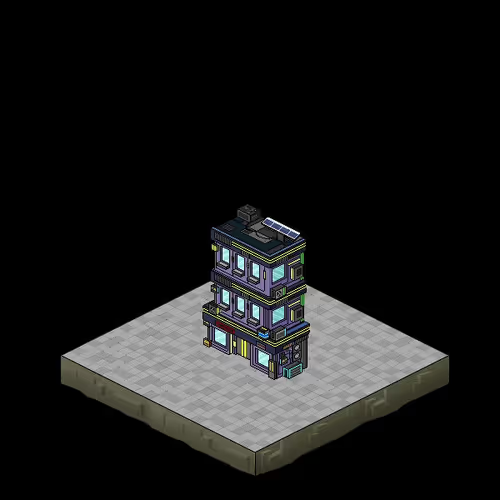
Estate 04Base Parcel House
- Class
- Tier 1
- Weight
- 1.00x
- District
- East Yard
Estate Operating System
Not a promise page. A machine with parts.
The utility layer is written as if the collection has a back office: registry, oracle, activation bills, rent ledger, reserve pool and failure controls. It feels more serious because the moving pieces are visible.Each NFT becomes a readable property record with class, weight, district, listing state and activation history.
The app reads a filtered floor reference, ignores duplicate seller pressure and smooths the value before activation math.
Active houses earn Rent Points by hours, tier weight, holder conviction and district occupancy.
Utility spend is metered from a finite reserve instead of pretending the machine has infinite rewards.
Future block rooms can set estate capacity, giving collectors a reason to assemble neighborhoods instead of single flips.
Genesis estates sit on the top lane for boosts, early windows, governance weight and collector status.
Property Classes
Tier controls weight, windows and ceilings
TierTitleWeightLease WindowCeilingRole
Tier 1Base Parcel1.00x24h1.20%entry allocation
Tier 2Upper Unit1.55x18h1.80%stronger rent weight
Tier 3Prime Block2.65x12h2.70%priority district lane
GenesisCorner Estate5.00x8h4.00%top registry status
Estate Math
Complex enough to feel engineered, simple enough to audit
These formulas are presentation-grade proposed mechanics for the Block Estates handbook. They create the same feeling as a serious protocol doc without using guaranteed-yield language.median(lowest_5_listings_unique_sellers)max(1, 1.42 x floor_ref^0.84) x tier_weightmin(tier_ceiling, reserve_balance x 0.08 / open_bills + tier_base)active_hours x tier_weight x conviction_multiplier x occupancy_bonusDocumentation